
What this AI growth page is really about
This page is for founders, operators, and marketers asking where AI creates real business value. It focuses on how AI helps teams discover demand, identify new positioning angles, and turn messy user data into growth decisions.
MANUAL INQUIRY
Need ClaudeCode or GPT recharge help?
Use the inquiry pages for ClaudeCode, GPT recharge, assisted purchase, and team sourcing.
Automatic payment is not configured. Pricing, region support, and timing are confirmed manually.
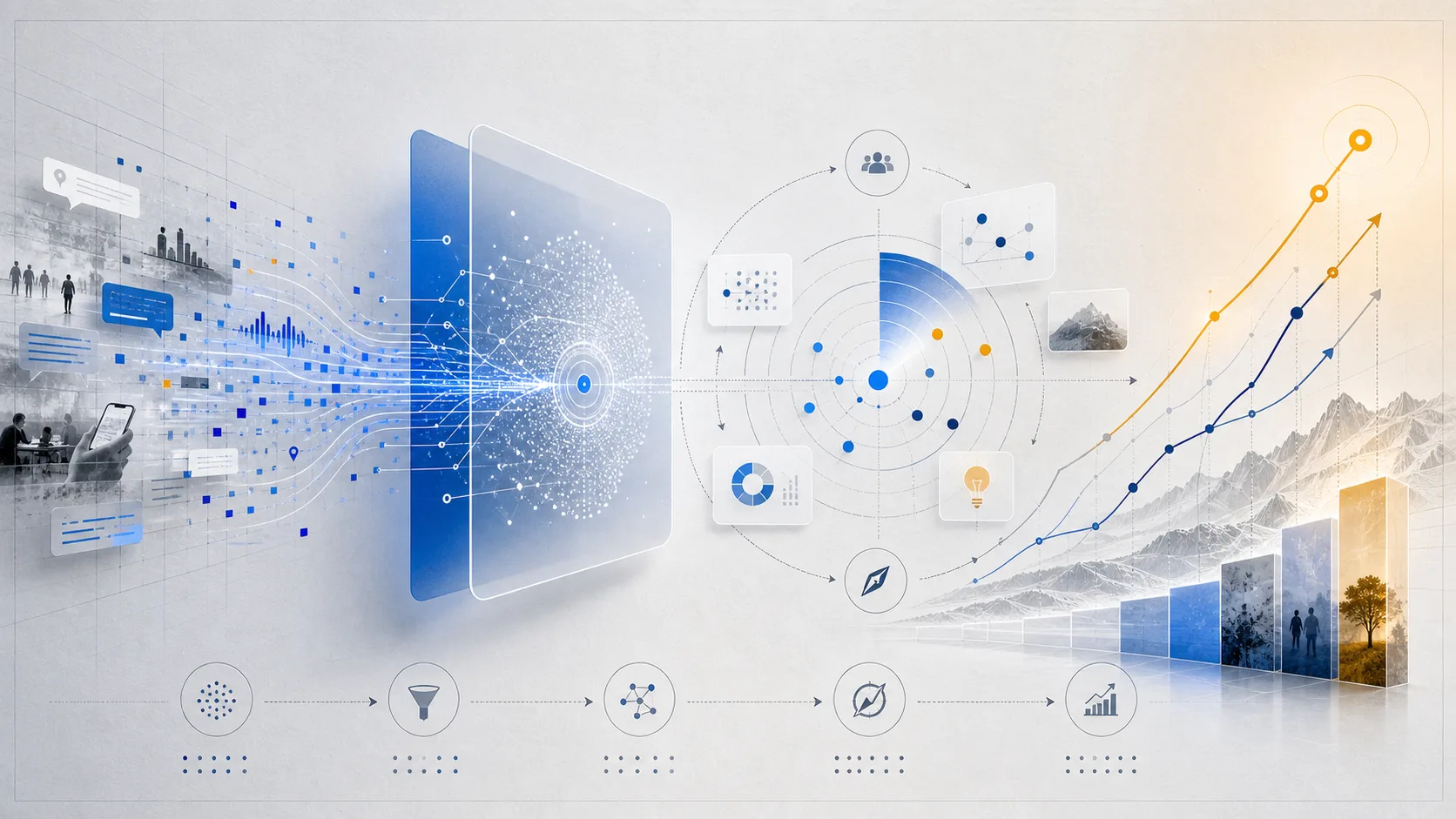
AI's Real Impact on Business Is Not Labor Replacement. It Is Growth Discovery.
Intro:
When a five-person team can generate 6,000 ad videos in a single day, AI content production is no longer a demo capability. It is a scalable delivery capability. What matters is not only that a 15-second AI ad can cost RMB 10-15 instead of RMB 25-50, but that AI is now able to detect new needs, new selling points, and new product opportunities from customer service, after-sales, and user feedback data.
One Number Should Change How Companies Think About AI
There is one number that I think many companies should take seriously:
A five-person team can generate 6,000 ad videos in one day.
A year ago, a claim like this would have sounded like a flashy demo. It might have been impressive, but not necessarily operational. Today, it signals something much more important:
AI content production is no longer a demo-level capability. It has become a scalable production capability that can enter real business workflows.
The first visible change is simple: the economics of content production are being rewritten.
AI Is Rewriting the Cost and Capacity Structure of Marketing

Today, a 15-second AI-generated ad can cost around RMB 10-15, while a comparable human-produced ad often costs RMB 25-50.
That sounds like a cost reduction story, but it is more than that. For businesses, this is not just about making one ad more cheaply. It changes how marketing teams test ideas, allocate budgets, and validate messages.
In the past, companies did not fail to test more creative ideas because they lacked imagination. They failed because:
- production costs were too high
- coordination chains were too long
- timelines were too slow
- revisions and reshoots were too expensive
As a result, many ideas that should have been tested in the market died inside internal workflows.
AI changes that.
For the first time, companies can:
- produce more content at lower marginal cost
- test more versions of the same message
- validate different audiences, offers, and positioning angles quickly
- run experiments that were previously too slow or too expensive
So the first layer of change is clear:
AI is rewriting marketing capacity and the cost of experimentation.
But if a company only sees this layer, it is still underestimating AI.
The Bigger Value Is Not Cost Savings. It Is Demand Discovery.

If AI only made advertising cheaper, it would still be useful. But that is not the biggest story.
The bigger story is this:
AI is starting to help companies see demand they could not see before.
A high-end home appliance case makes this point especially clear.
The company did not begin by asking AI to replace creative staff or mass-produce ads. Instead, it fed AI with large volumes of:
- customer service conversations
- after-sales records
- user feedback
What AI produced was not just faster content production. It revealed demand patterns that human teams had not recognized.
The company then adjusted its marketing language and sales strategy. The results were significant:
- sales increased by 23%
- average order value in the premium product line increased by 60%
This is the critical lesson:
Most companies do not lack data. They lack the ability to convert fragmented data into growth insight.
Why Companies Have Data but Still Miss Growth
Customer support teams collect conversations every day. After-sales teams collect problems every day. Sales teams hear objections every day. Marketing teams see campaign performance every day.
The problem is not the absence of data. The problem is that the data is:
- fragmented
- noisy
- distributed across teams
- difficult for humans to synthesize at scale
Humans can notice cases. They struggle to detect patterns across thousands of conversations, complaints, and signals.
This is where AI becomes strategically valuable.
AI can identify:
- repeated complaints
- hidden preferences
- real purchase concerns
- recurring but unnamed demand signals
In other words, AI is not only helping companies create content faster. It is helping them understand the market more deeply.
Labor Savings Are a Small Equation. Growth Is the Bigger Equation.

Many companies still ask the same first question:
How many people can AI replace?
That is not a wrong question. It is just too small.
Labor savings are mostly efficiency gains. They optimize an existing system. And once a capability is widely available, competitors can do the same thing.
But growth discovery is different.
If AI helps a company discover:
- a new customer need
- a more convincing selling point
- a higher-value audience segment
- a new product opportunity
then the outcome is not linear savings. It is nonlinear growth.
A useful distinction is this:
Cost reduction optimizes the existing system.
Growth discovery opens new revenue space.
That is why the companies that truly benefit from AI will not confine it to content teams alone. They will integrate it into operating and decision systems.
How Companies Should Actually Use AI
I think companies should use AI across at least three layers.
Layer 1: Content Production
Use AI to generate video, visuals, scripts, copy, and multiple creative versions.
The point is not to make one beautiful ad. The point is to build a repeatable, low-cost testing engine.
Layer 2: User Insight
Feed AI with customer support logs, after-sales tickets, sales conversations, reviews, and private community chats.
Use it to extract:
- what customers actually care about
- why they hesitate
- which pain points recur
- which messages resonate with higher-value buyers
This layer is no longer about efficiency. It is about market understanding.
Layer 3: Growth Decision-Making
When AI stops answering only "which ad gets better clicks?" and starts answering:
- which segment cares about what
- which message supports higher average order value
- which use case deserves its own product
- which demand signal can become a new growth entry point
it stops being just a tool and starts becoming part of the company's decision system.
At that point, AI becomes:
- a demand discovery tool
- a product opportunity tool
- a growth leverage tool
Companies Need Better Questions
The biggest misunderstanding many companies have about AI is that they ask questions that are too small.
They ask:
How many people can AI replace?
But the better questions are:
- Can AI help us see customer demand we have missed?
- Can AI help us find selling points we have communicated poorly?
- Can AI help us identify a new growth angle?
- Can AI help us detect a product opportunity before competitors do?
If the answer is yes, then AI is not just a labor replacement tool.
It is a strategic growth system.
Conclusion
So when a five-person team can generate 6,000 ad videos per day, the real significance is not that AI has become good at content creation.
The real significance is this:
Once the production barrier for content is flattened, competitive advantage will no longer come from who produces more content. It will come from who uses AI to see growth that others still cannot see.
AI's greatest value is not replacing labor.
Its greatest value is helping companies discover growth they could not see before.
Closing line:
The companies that will be pulled ahead by AI are not the ones that use it first to cut headcount. They are the ones that use it first to discover growth.
Visual Assets


MANUAL INQUIRY
Need ClaudeCode or GPT recharge help?
Use the inquiry pages for ClaudeCode, GPT recharge, assisted purchase, and team sourcing.
Automatic payment is not configured. Pricing, region support, and timing are confirmed manually.