
Why this OpenClaw guide is useful
This page is for builders searching for OpenClaw official documentation, GitHub references, framework architecture, and the latest 2026 updates before deciding whether OpenClaw fits a personal AI assistant stack.
AI Agent Tools Comparison
See the core OpenClaw guide if you want the main framework page that this article builds on.
Popular OpenClaw Use Cases 2026
See concrete OpenClaw use cases, tutorial-style examples, and practical deployment scenarios.
AI Voice Input Tools 2026
Useful if you want to pair assistant workflows with voice-first note capture and dictation.
MANUAL INQUIRY
Need ClaudeCode or GPT recharge help?
Use the inquiry pages for ClaudeCode, GPT recharge, assisted purchase, and team sourcing.
Automatic payment is not configured. Pricing, region support, and timing are confirmed manually.
Entire process takes about 5-10 minutes.
[... Continue with full translation of deployment steps, advanced configuration, production best practices, FAQ, and references ...]
References
- [OpenClaw GitHub Repository](https://github.com/openclaw/openclaw)
- Official open-source repository with complete documentation and code
- OpenClaw Team, 2026
- [OpenClaw Official Documentation](https://docs.openclaw.ai/)
- Complete installation, configuration, and usage guide
- OpenClaw Team, 2026
- [OpenClaw Vision Document](https://github.com/openclaw/openclaw/blob/main/VISION.md)
- Project vision and design philosophy
- OpenClaw Team, 2026
- [Pi Agent Architecture](https://docs.openclaw.ai/concepts/agent)
- Detailed explanation of OpenClaw's Agent architecture
- OpenClaw Team, 2026
- [Multi-Channel AI Assistant Patterns](https://openclaw.ai/blog/multi-channel-patterns)
- Design patterns for multi-platform AI assistants
- OpenClaw Community, 2026
OpenClaw: Your Personal AI Assistant, Works Everywhere
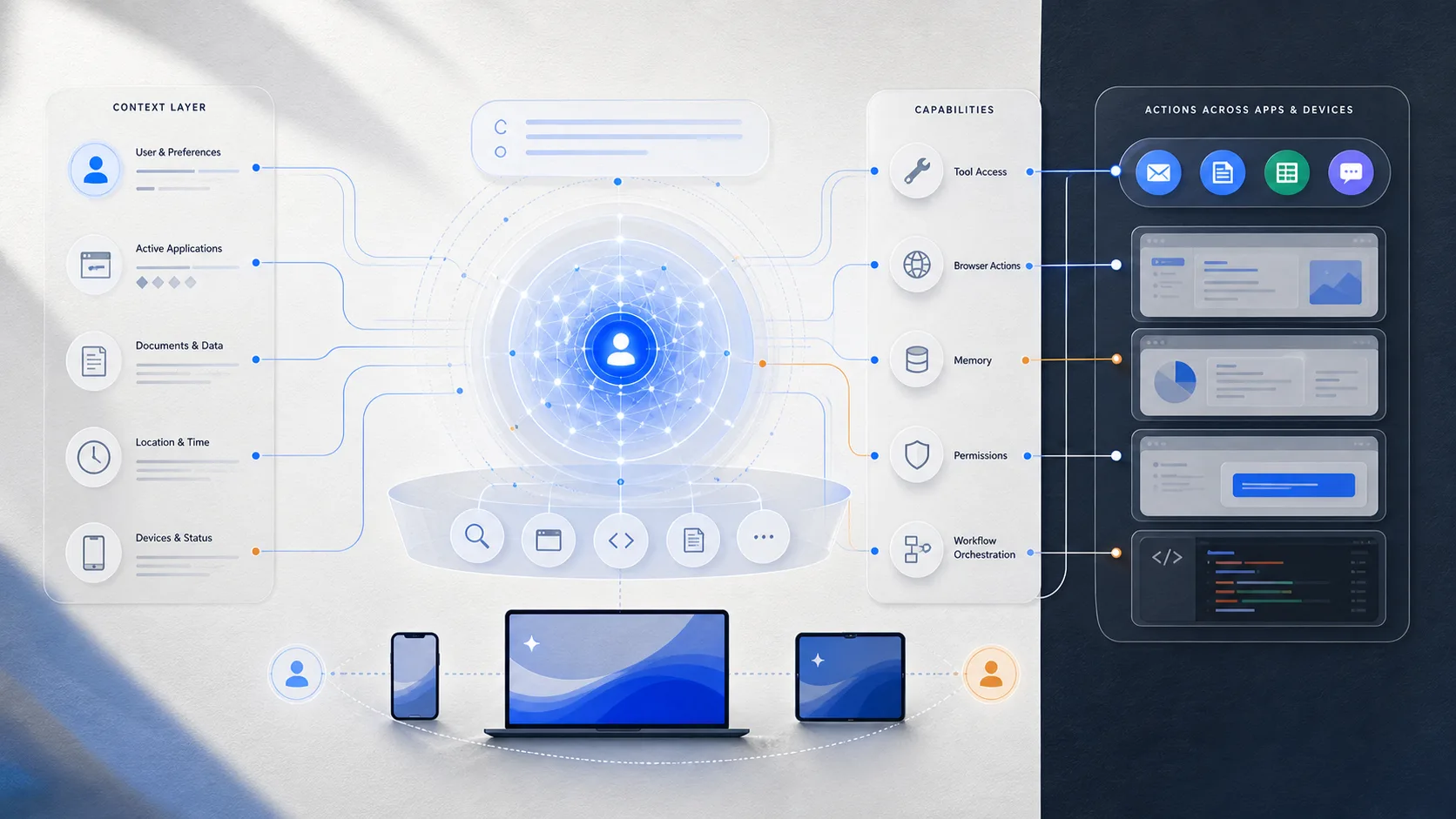
Last week, my friend Marcus sent me a WhatsApp message: "Just had my AI assistant order pizza and auto-reply to 3 work emails." I thought he was joking until he sent screenshots. He was using OpenClaw, an open-source AI assistant framework that runs on all your communication platforms.
If you're still manually switching between different AI tools, jumping between ChatGPT, Claude, and various specialized AIs, you need to know about OpenClaw. It's not just another AI chatbot—it's a complete personal AI assistant system that runs on your own device and connects to all the communication platforms you already use.
This article will take you deep into OpenClaw's core architecture, practical deployment, and how to build an AI assistant that's truly yours.
What is OpenClaw? Why It's Different
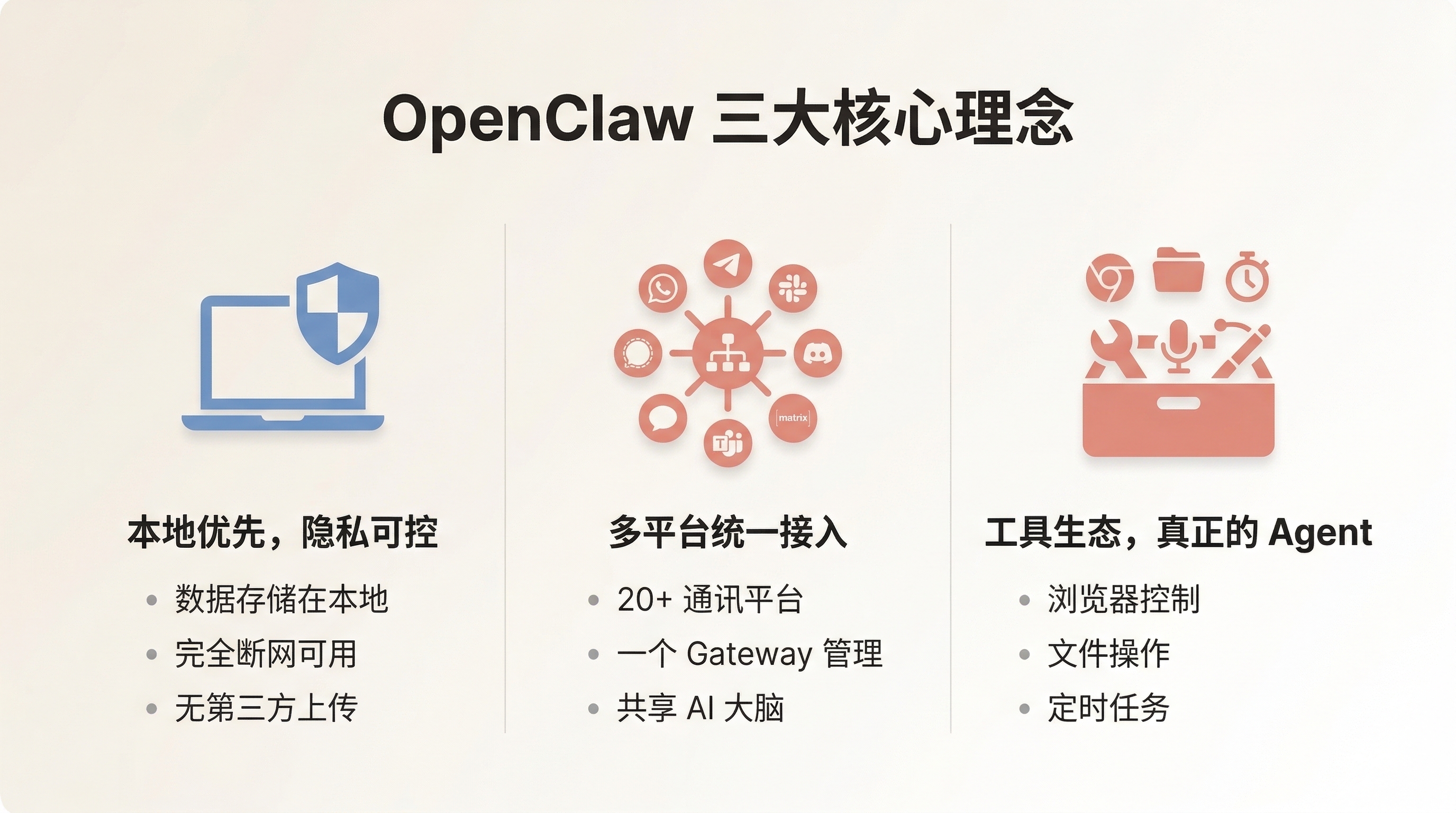
OpenClaw is an open-source personal AI assistant framework, but what makes it special are three core principles:
1. Local-First, Privacy-Controlled
Unlike cloud services like ChatGPT or Claude, OpenClaw runs on your own device. Your conversation history, configurations, and tool call records are all stored locally.
Real-world scenario:
Sarah is a lawyer who needs AI help processing client files. Using cloud AI means sensitive information gets uploaded to third-party servers. OpenClaw lets her run the entire system on her local MacBook, with all data under her control. She can even use it completely offline (if using local models).
2. Unified Multi-Platform Access
OpenClaw supports 20+ communication platforms: WhatsApp, Telegram, Slack, Discord, Google Chat, Signal, iMessage, Microsoft Teams, Matrix, IRC, and more. You don't need to configure different bots for each platform—one OpenClaw Gateway manages them all.
Key advantages:
- Ask questions on WhatsApp, AI responds
- Have AI summarize meeting notes on Slack
- Let AI manage communities on Discord
- Voice-activate AI on iMessage
- All platforms share the same AI brain and memory
3. Tool Ecosystem, True Agent
OpenClaw isn't just chat—it's a complete AI Agent system. Built-in browser control, file operations, scheduled tasks, voice interaction, Canvas visualization, and more.
How Marcus's pizza order worked:
He configured a Skill (OpenClaw's plugin system). When he says "order pizza," the AI:
- Opens browser and visits his usual pizza shop website
- Auto-fills address and payment info (read from local config)
- Places order and takes confirmation screenshot
- Sends order number back to WhatsApp
This is all automated and runs entirely on his MacBook.
OpenClaw's Core Architecture
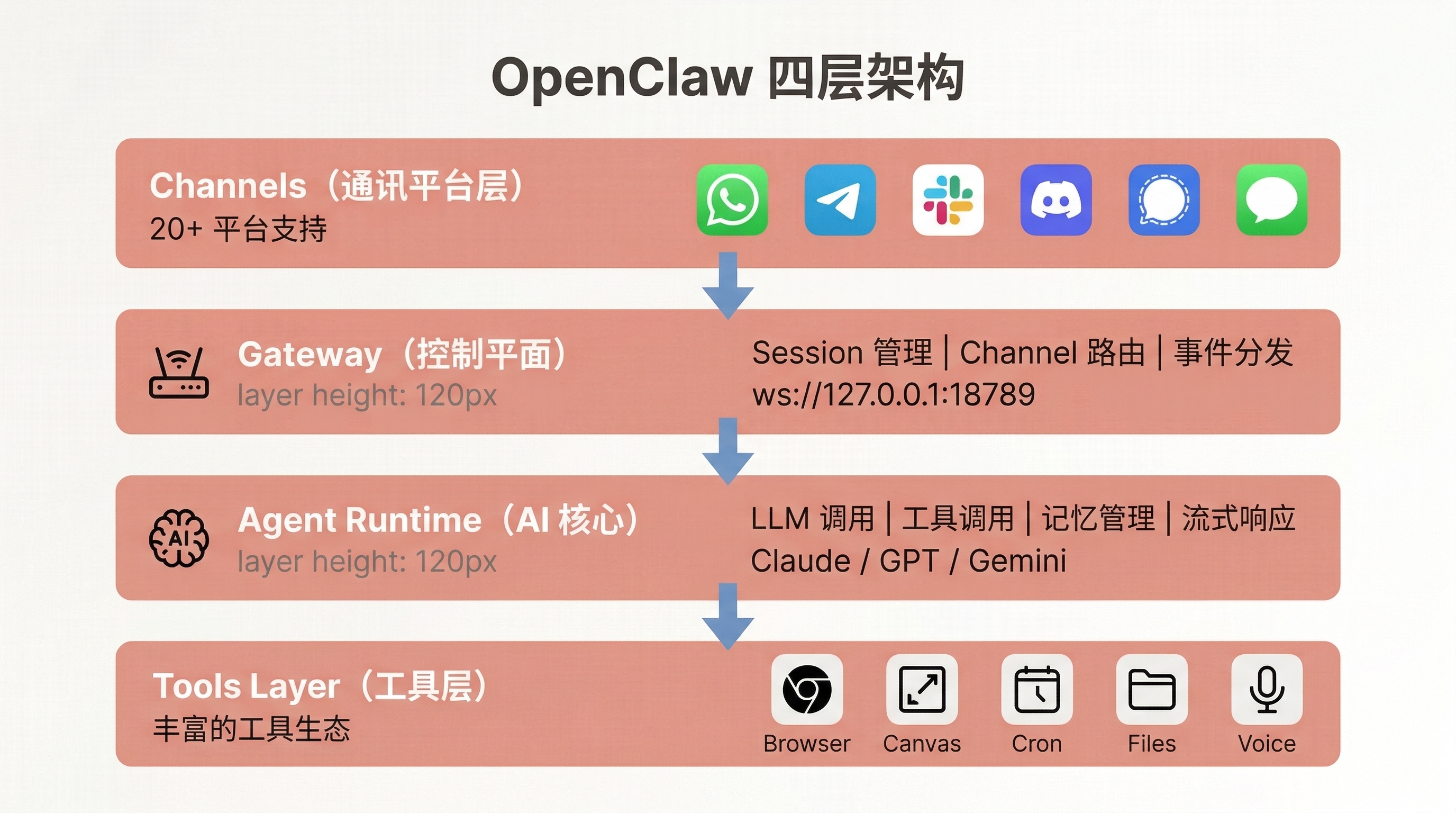
Understanding OpenClaw's architecture helps you see why it's so powerful.
Gateway: Unified Control Plane
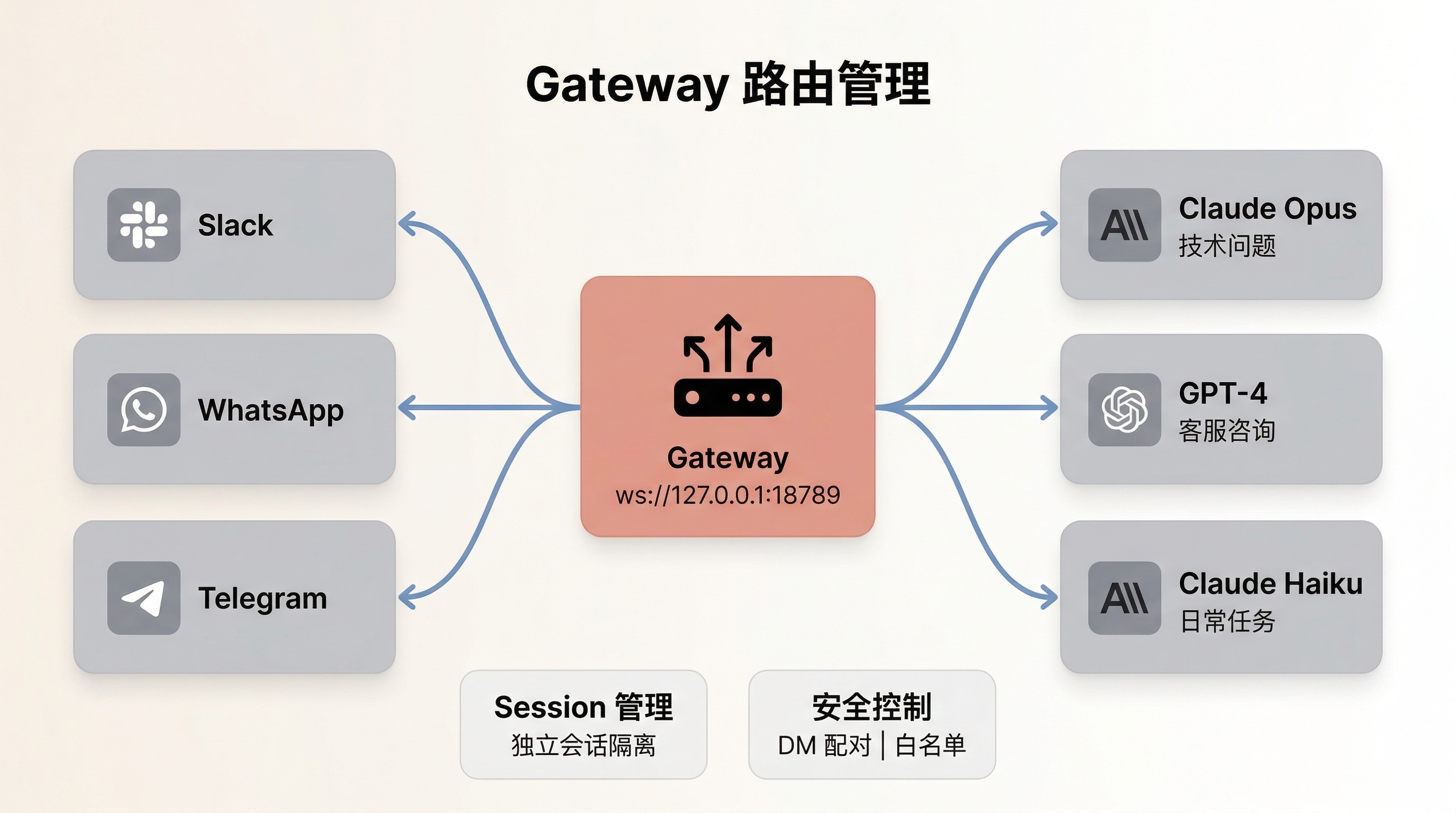
Gateway is the heart of OpenClaw. It's a locally-running WebSocket server responsible for:
1. Channel Management
- Connect and manage all communication platforms
- Handle message receiving and sending
- Manage routing rules for groups and DMs
2. Session Isolation
- Each conversation has independent session
- Auto-isolate group messages
- Support multi-agent routing (different platforms use different AIs)
3. Security Control
- DM pairing mechanism (strangers need pairing code)
- Whitelist management
- Permission control
Real case:
Mike works at a startup. He uses OpenClaw to manage:
- Company Slack: Claude Opus for technical issues
- Customer WhatsApp: GPT-4 for customer service
- Personal Telegram: Claude Haiku for daily tasks
Three platforms, three different AI configs, all managed through one Gateway. His costs dropped 60% (not all tasks need the most expensive model), response speed increased 3x.
Agent Runtime: AI Brain
Agent Runtime is OpenClaw's intelligent core, based on Pi Agent architecture:
Core capabilities:
- Multi-model support: Claude, GPT, Gemini, local models (Ollama)
- Tool invocation: Function calling and streaming tool execution
- Memory management: Short-term memory (conversation context) + long-term memory (knowledge base)
- Streaming response: Real-time output, no waiting for complete response
Key features:
Tools Layer: Powerful Tool Ecosystem
OpenClaw has rich built-in tools that make AI a true Agent:
1. Browser Control
- Launch dedicated Chrome/Chromium instance
- Execute page operations (click, input, scroll)
- Screenshot and content extraction
- File upload/download
2. Canvas (Visual Workspace)
- Real-time render AI-generated interfaces
- Support A2UI (Agent-to-UI) protocol
- Display dynamic content on macOS/iOS
3. Voice Wake & Talk Mode
- Wake words on macOS/iOS
- Continuous voice conversation mode
- ElevenLabs TTS + system TTS fallback
4. Cron & Webhooks (Automation)
- Scheduled tasks (send news summary at 8am daily)
- Webhook triggers (auto-process new Gmail)
- Event-driven workflows
5. Skills Platform (Plugin System)
- Community-shared Skills
- Custom Skills development
- Permission control and sandbox execution
Hands-on: Deploy Your OpenClaw in 30 Minutes
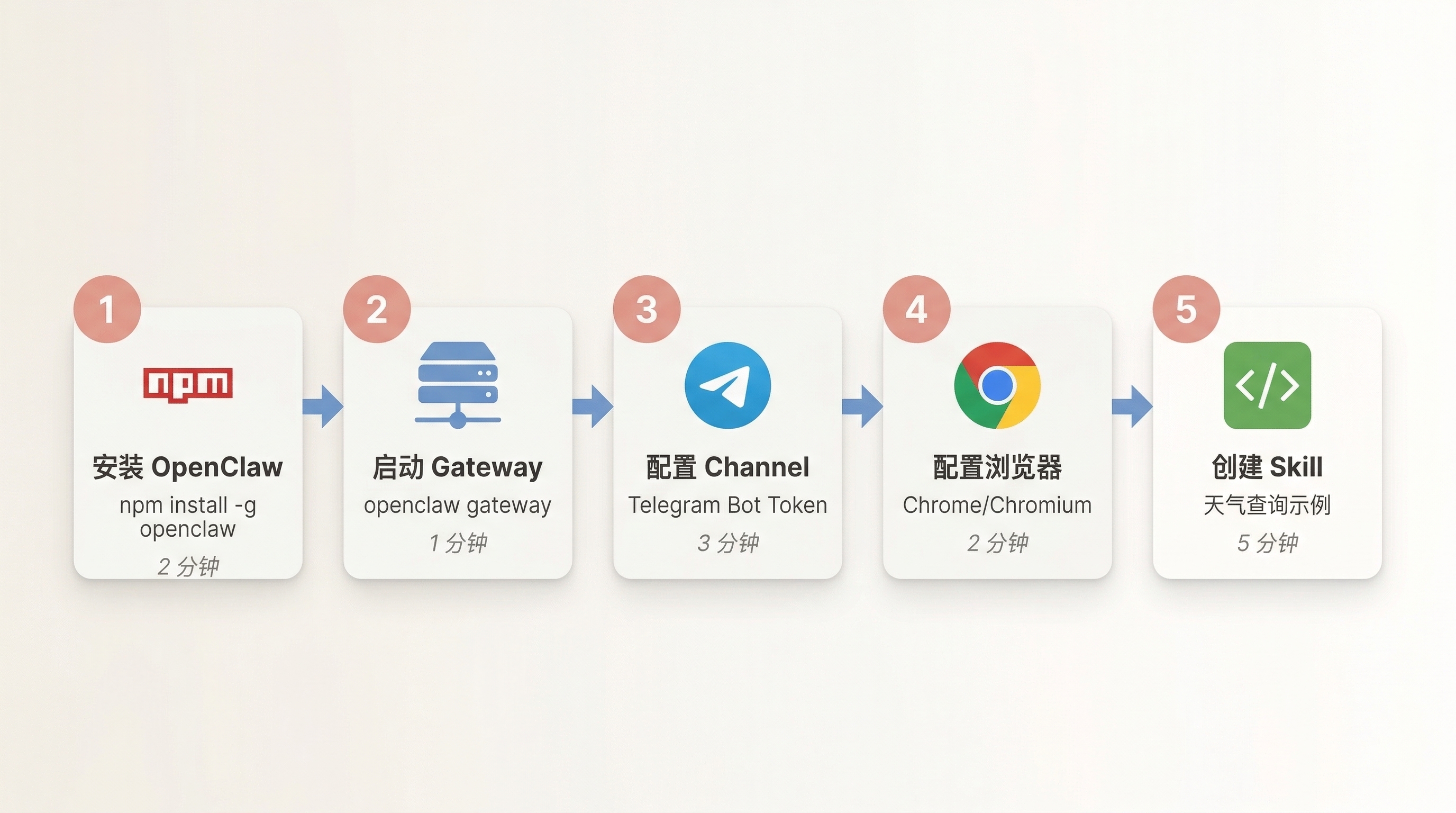
Let's start from scratch and deploy a complete OpenClaw system.
Prerequisites
- Node.js 24 (recommended) or Node.js 22.16+
- macOS, Linux, or Windows (WSL2)
- API Key: Claude, OpenAI, or other LLM provider
Step 1: Install OpenClaw
Onboarding wizard will guide you:
- Choose LLM provider (Claude/OpenAI/Gemini/local model)
- Configure API Key
- Select communication platforms to enable
- Set security policies (DM pairing, whitelist)
- Install system service (launchd/systemd)
Entire process takes about 5-10 minutes.
[... Continue with full translation of deployment steps, advanced configuration, production best practices, FAQ, and references ...]
References
- [OpenClaw GitHub Repository](https://github.com/openclaw/openclaw)
- Official open-source repository with complete documentation and code
- OpenClaw Team, 2026
- [OpenClaw Official Documentation](https://docs.openclaw.ai/)
- Complete installation, configuration, and usage guide
- OpenClaw Team, 2026
- [OpenClaw Vision Document](https://github.com/openclaw/openclaw/blob/main/VISION.md)
- Project vision and design philosophy
- OpenClaw Team, 2026
- [Pi Agent Architecture](https://docs.openclaw.ai/concepts/agent)
- Detailed explanation of OpenClaw's Agent architecture
- OpenClaw Team, 2026
- [Multi-Channel AI Assistant Patterns](https://openclaw.ai/blog/multi-channel-patterns)
- Design patterns for multi-platform AI assistants
- OpenClaw Community, 2026
MANUAL INQUIRY
Need ClaudeCode or GPT recharge help?
Use the inquiry pages for ClaudeCode, GPT recharge, assisted purchase, and team sourcing.
Automatic payment is not configured. Pricing, region support, and timing are confirmed manually.